A glossary, a practical exercise and a record of changes to this companion. Start with a question from your own work.
An exercise for individuals or teams
A deliberate delegation
Choose one specific task. Fill in the six fields, discuss your choices, then compare the result with what happened in practice. This is a discussion aid inspired by the book, not a validated assessment or a maturity score.
See a completed example (illustrative, not a real case study)
Task and intended result
Prepare a summary of a public report for an internal meeting.
What you delegate to AI
A first draft with page references. No automatic sending.
Permitted data and sources
Only the approved report. No personal or confidential data.
What you verify and against which criteria
Check figures, quotations and conclusions against the document, including what was omitted.
Who is accountable for the result
The person presenting the summary reads the original report and approves the final version.
When to stop and take control back
If a source is missing, the document is ambiguous or a conclusion cannot be checked, stop and reread the passage.
Your answers stay on this page and are not submitted. Download them before leaving; reloading or leaving this page clears them.
Short working definitions. Entries describing my concepts are identified as such; each links to a chapter for context.
RAG
Generation using documents retrieved from an external source as context. Retrieval does not remove the need to verify. Read in context →
SLM
A relatively small language model. Size alone does not determine fitness for a task. Read in context →
Agency and delegation
The capacity to act in a context. The book uses organisational delegation to discuss goals, constraints and oversight. Read in context →
Metacognition
Reflecting on how we know and on the limits of our judgement: recognising when we cannot verify. Read in context →
Cognitive drift
In my interpretive model, a gradual shift from AI support to dependence on its judgement. Not a clinical diagnosis. Read in context →
Qualified cognitive surrender
Deliberate delegation: choosing the task, retaining checks and knowing when to take judgement back. Read in context →
System 0
A theoretical lens on external systems contributing to human thought; not a newly identified brain region. Read in context →
Onto-ethics
In the book’s argument, reflection on what the actors in a system are and what responsibilities follow from their roles. Read in context →
Epistemic security
Conditions for knowing the origin, limitations and verifiability of information used in decisions. Read in context →
Split habitus
Tension between learned dispositions and a different social context. The book uses it to interpret adaptation. Read in context →
A(I)DOPTION
About me’s proposed method for organisational AI adoption. A working approach, not a certification. Read in context →
A(I)DAPTATION
The continuing practice of revisiting habits and responsibilities after AI is introduced. Read in context →
Companion changelog
What has changed
A more useful reading companion
Searchable index, clearer chapter connections, references cited in my book, a glossary and a delegation worksheet. The summaries on value, data, agents and cognition have been revised to distinguish interpretation from evidence.
This records changes to the website. It does not announce a new edition or amendments to the printed book.
For a presentation, reading group or review, these materials provide a starting point. Contact me to discuss participation or permissions.
Short synopsis
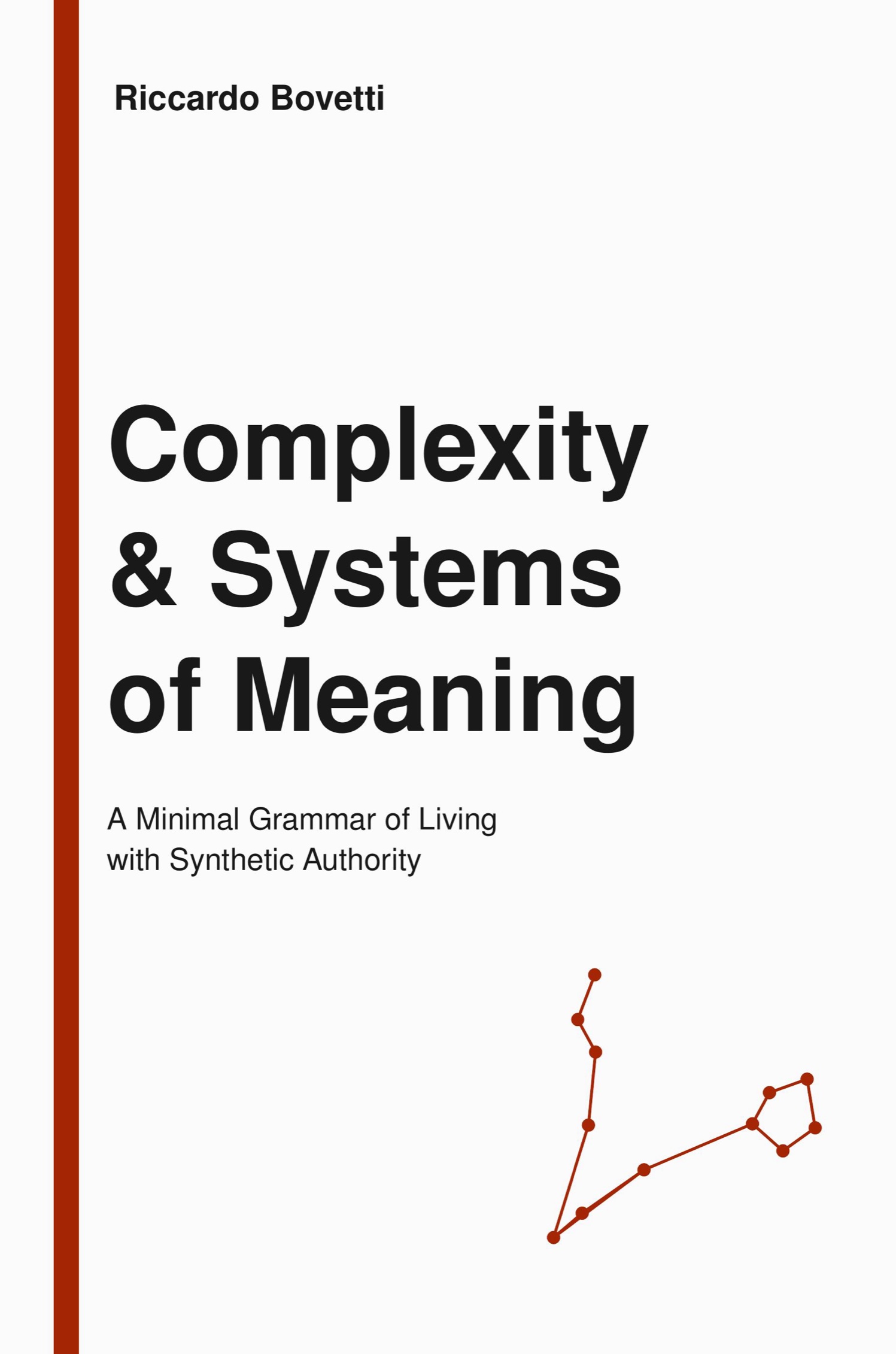
In Complexity & Systems of Meaning I examine how AI changes professional judgement, expertise and responsibility. Across twelve chapters and two appendices, I connect organisational transformation with the experience of people who delegate parts of their work to artificial systems.
About me
I work at the boundary between consulting, applied research and teaching. For almost thirty years, as a Partner at EY, I have supported organisations and leaders through deep transformations. I teach management control, Big Data, analytics and artificial intelligence at universities and business schools.
Three questions for a discussion
When does delegation become a loss of judgement?
What separates adopting a tool from changing an organisation?
For reproduction of plates or extended excerpts, agree usage with me.
Occasional notes
Stay with the questions.
My notes on AI, organisations and systems of meaning. A way to continue the conversation beyond the book, without a fixed schedule.
The subscription form is provided by Kit. Opening it loads the provider’s form; subscribing sends your details to my mailing list through Kit. Kit privacy policy