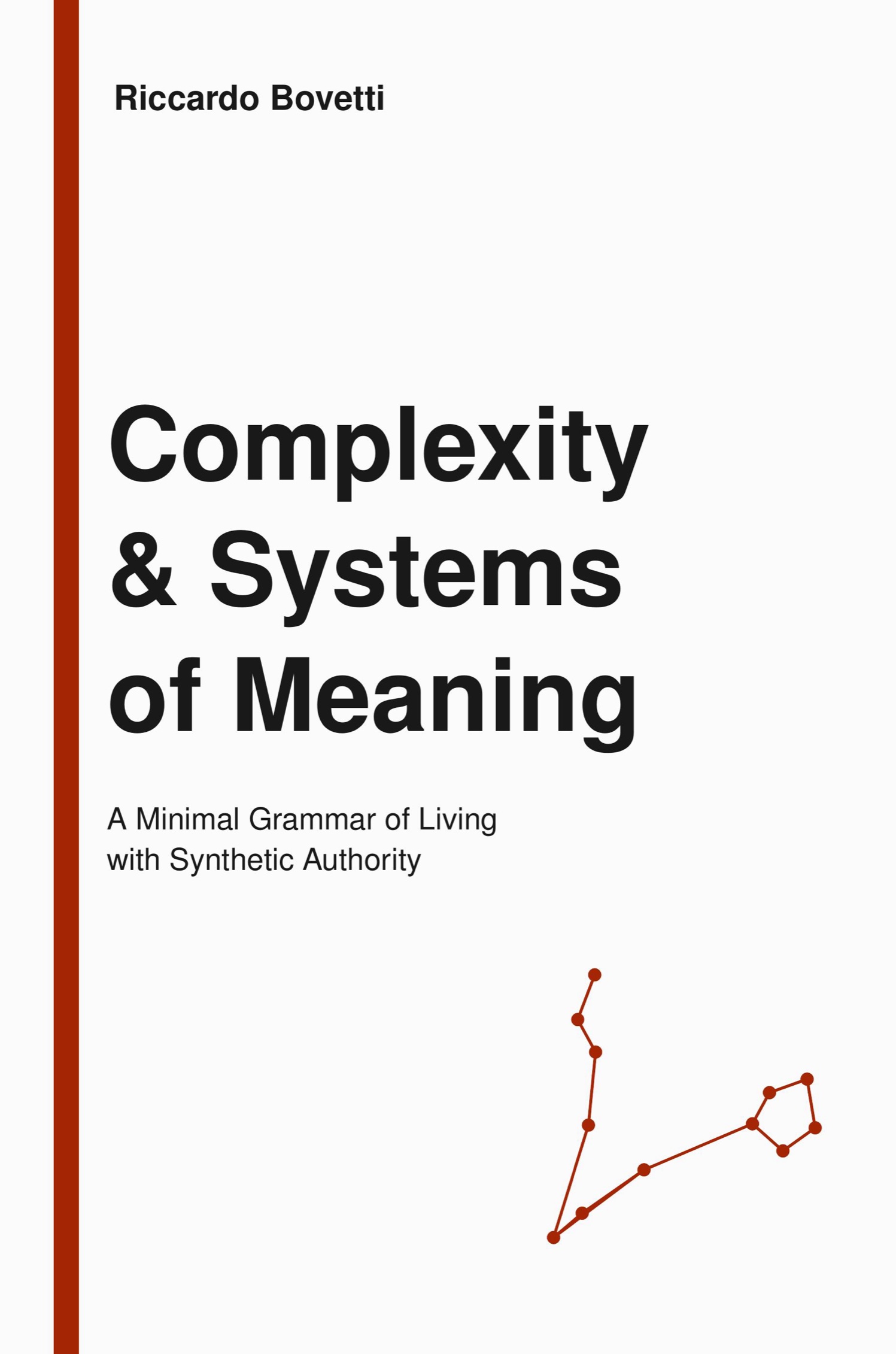
In this book I explore what happens to expertise, responsibility and the way we think when AI becomes part of ordinary work. I offer questions and interpretive frameworks for decisions that remain human.
For you if…
You lead people, projects or professional decisions.
You want to distinguish useful delegation from loss of judgement.
You want a critical perspective spanning organisations and individual experience.
What to expect
An argumentative essay, not a collection of prompts or a technical product manual. No programming knowledge is required; the glossary supports the philosophical and organisational vocabulary.
I work at the boundary between consulting, applied research and teaching. For almost thirty years, as a Partner at EY, I have supported organisations and leaders through deep transformations. I teach management control, Big Data, analytics and artificial intelligence at universities and business schools.
I try not simply to pass on facts, but to build frameworks for finding a way through ambiguity. I am interested in where theory encounters the friction of reality.
Before deciding where to go, it helps to know where we are. And to discover, with a certain unease, that it is not where we thought: the authority to answer the questions that matter has shifted again, innovation is not where the narrative places it, ethics does not live in compliance documents.
There is a revolution, but not the one we are told about. It lies not in the bigger model nor in faster adoption, but in the capacity — far less spectacular and far more laborious — to turn one's own data, processes and skills into defensible value. It is a game of relevance, not of power.
The real bottleneck is not technological: it is cognitive, relational, ethical. Generative AI is not a neutral tool we pick up and put down, but an agent that reshapes our mental space while we use it, changing how we think, how we collaborate and whose the responsibility is.
Adopting AI is a project that sooner or later ends; living with it is a condition that remains. From here on the question is no longer “how”, but who we become when coexistence with artificial systems stops being an episode and becomes the environment we live in.
Choose a task, define what AI may do and decide how you will check the result. The worksheet includes an illustrative example to discuss with your team.
The links open the store; they do not purchase the book.
Occasional notes
Stay with the questions.
My notes on AI, organisations and systems of meaning. A way to continue the conversation beyond the book, without a fixed schedule.
The subscription form is provided by Kit. Opening it loads the provider’s form; subscribing sends your details to my mailing list through Kit. Kit privacy policy